Govern the decision
The agent team recommends an outcome. Decision Policy determines whether that recommendation is eligible to influence Argo Rollouts. It is implemented in Java/Quarkus, primarily in DecisionPolicy.java, with orchestration and release-identity checks at the service/API boundary. It is a deterministic set of application rules, evaluated independently of the LLM’s recommendation.
The policy covers four practical concerns:
- Traffic and freshness: at least 30 requests per revision, with decisions expiring 120 seconds after evidence capture.
- Evidence quality: HOLD for missing required evidence, invalid references, unsuccessful mandatory tool reads, or unresolved limitations.
- Customer safety: enforce error, latency, and retry limits; an LLM GO cannot override them. The retry safety budget produces NO-GO when canary attempts per checkout exceed 2 AND exceed twice stable, with a sampled retrying canary request and its trace-linked log. Fresh, complete evidence and at least 30 requests per cohort remain prerequisites. Approval cannot override NO-GO.
- Human approval: production promotion requires an explicit presenter approval when the recommendation is otherwise eligible.
The SPA’s expandable Decision Policy explanation summarizes these rules. Evidence explorer shows their resulting effective decision.
1. Demonstrate human-in-the-loop (HITL) approval
Choose Development / no approval for the core slowdown/retry flow. Choose Production / approval before a fresh investigation when demonstrating human approval. The selection applies to the next investigation; changing the dropdown does not alter a completed or running decision. Repeat the fresh investigation and approval at each Production gate.
This HITL capability already exists. Use it as an Extended demonstration after the core shared-slowdown/retry story, so the audience first understands investigation and then sees the authority boundary.
- At an active analysis gate, wait for the green readiness cue and fresh observations for both revisions.
- Select Production / approval and run the four-agent investigation explicitly.
- In Evidence explorer, compare the agent’s GO recommendation with the policy’s HOLD effective decision and approval requirement.
- Choose one action while the evidence is fresh: Approve promotion authorizes an eligible GO after rechecking policy; Decline promotion records a human NO-GO for this candidate and gate.
- Inspect the human review and timestamp in Evidence explorer. After a decline, the original agent recommendation remains GO and the effective decision is NO-GO. Neither button starts another LLM investigation or directly mutates the rollout.
- After approval, watch the rollout advance; the next Production gate needs a fresh investigation and approval. After decline, Argo aborts when it reads the decision; request a new candidate release to try again.
When the model recommends GO and all safety requirements pass, the effective result remains HOLD. The UI exposes Approve promotion and Decline promotion, with the consequences beside the controls. Both actions require the current fresh pending review and matching live release, stable baseline, and rollout stage. Approving the pending decision runs the policy checks again; it does not bypass them.
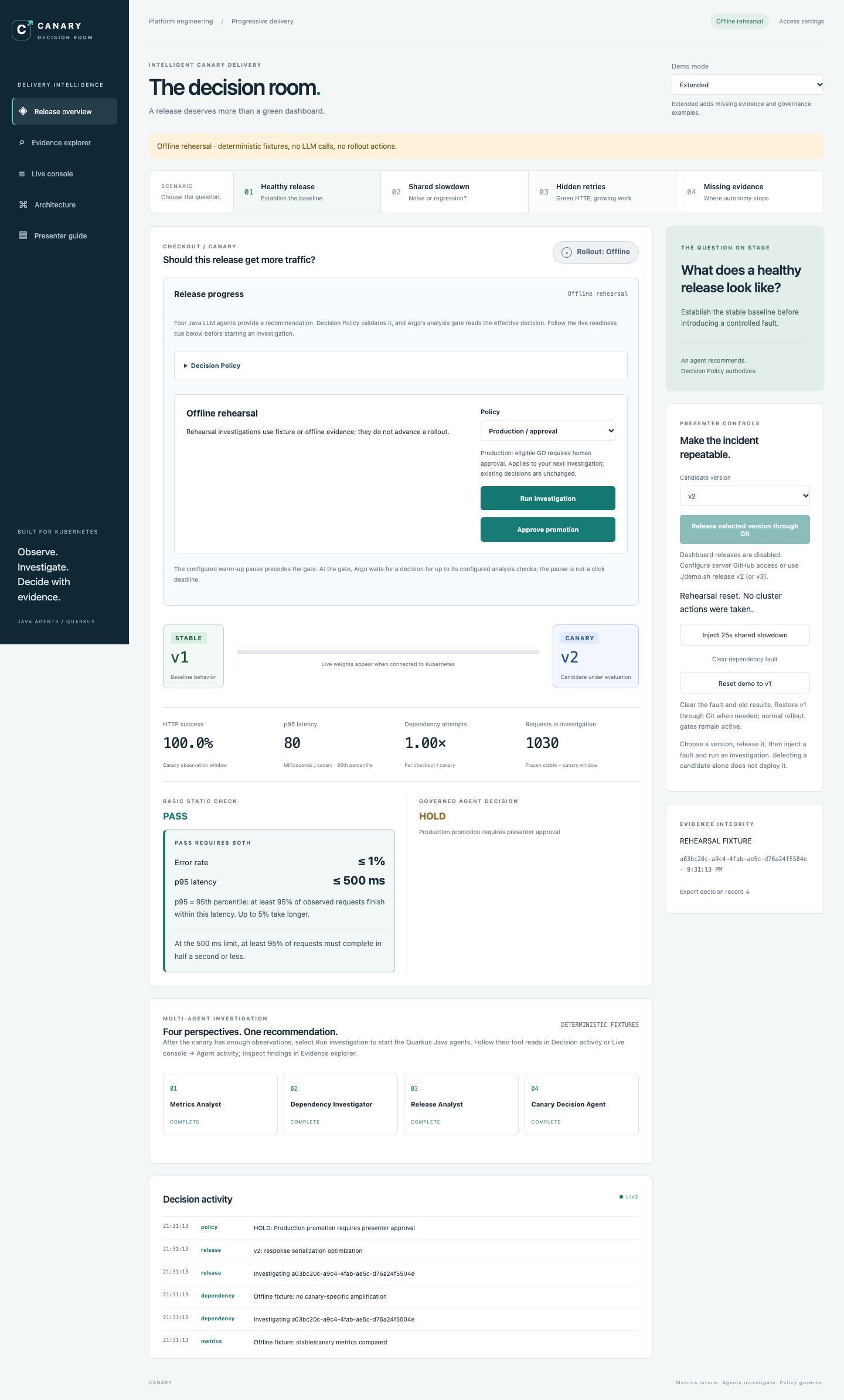
The presenter token authorizes this demonstration action. Production identity, role separation, and approval audit storage need their own implementation before using this design outside a demo.
2. Withhold required evidence
The lesson is absence of evidence is not evidence of safety. This scenario demonstrates a required evidence boundary, rather than another application failure.
Enterprise context and attendee insight
Illustrative case: a healthy-looking release coincides with a tracing collector outage, telemetry pipeline misconfiguration, or an access problem. HTTP success and latency remain green, but the platform cannot inspect required dependency observations. Promoting on that partial picture would turn uncertainty into permission.
In this demo, selecting Missing evidence and running an investigation deliberately withholds trace observations and records a presenter-injected trace evidence outage. Metrics remain observations from real cluster requests. It does not stop Jaeger or demonstrate an actual tracing backend failure. The recorded missing prerequisite makes deterministic Decision Policy return HOLD, irrespective of an optimistic model recommendation.
Explain the HOLD in plain language
“Required trace-linked request observations were deliberately withheld from this investigation. HTTP success and latency still look healthy, but the mandatory check of dependency and retry behavior is incomplete. Decision Policy holds promotion until a fresh investigation supplies the missing evidence.”
Evidence explorer shows this as Healthy metrics are not enough to authorize promotion, with the missing observation, its consequence, an enterprise example, and the next action. Use this explanation instead of only saying that an outage is a prerequisite. The required evidence is the prerequisite; the outage is the reason it is unavailable.
Contrast to share: scenario 03 has evidence of harmful retries and rejects the candidate with NO-GO. Scenario 04 lacks required corroboration and withholds judgment with HOLD. Human approval adds authorization; it cannot manufacture the missing observations.
Presenter sequence
- Use a healthy v2 candidate at an active analysis gate, with no shared slowdown and at least 30 observations in both cohorts. A completed/aborted gate needs a fresh release first.
- Select Development / no approval to isolate evidence completeness from the separate human-approval example.
- Switch Demo mode → Extended, choose Missing evidence, confirm candidate v2, and run the stage-specific investigation. Selecting the scenario alone does not run agents or change the cluster.
- Open Evidence explorer. Show healthy HTTP signals alongside the empty trace observations and missing-evidence entry in the raw observation window. Then show Recommendation → Decision Policy, the effective HOLD, and its missing-evidence reason. Release overview should show the same HOLD for that current stage; rollout identity is kept separately from the deliberately withheld traces. Distinguish any agent uncertainty from the platform's mandatory prerequisite.
- Explain that Approve promotion cannot override missing evidence. An approval supplies human authorization; it cannot supply observations that were never collected. NO-GO rejects an evidenced regression; this HOLD withholds judgment because required information is absent.
- Choose Healthy release, confirm the same active candidate, and investigate again to collect a fresh complete snapshot. This clears the scene's deliberate trace withholding; it does not repair a real external outage. If fresh evidence meets all rules and the agents support promotion, Development can produce GO; Production additionally requires eligible human approval.
Say: “The dashboard is green, but our required trace evidence is unavailable. The platform holds rather than turning uncertainty into permission. We restore evidence and reassess.”
Audience takeaway: trust in automation comes from explicit evidence requirements, controlled failure behavior, and reviewable decisions—not confidence in model wording. This is one deliberate missing-trace case; it is not a complete production observability or compliance system.
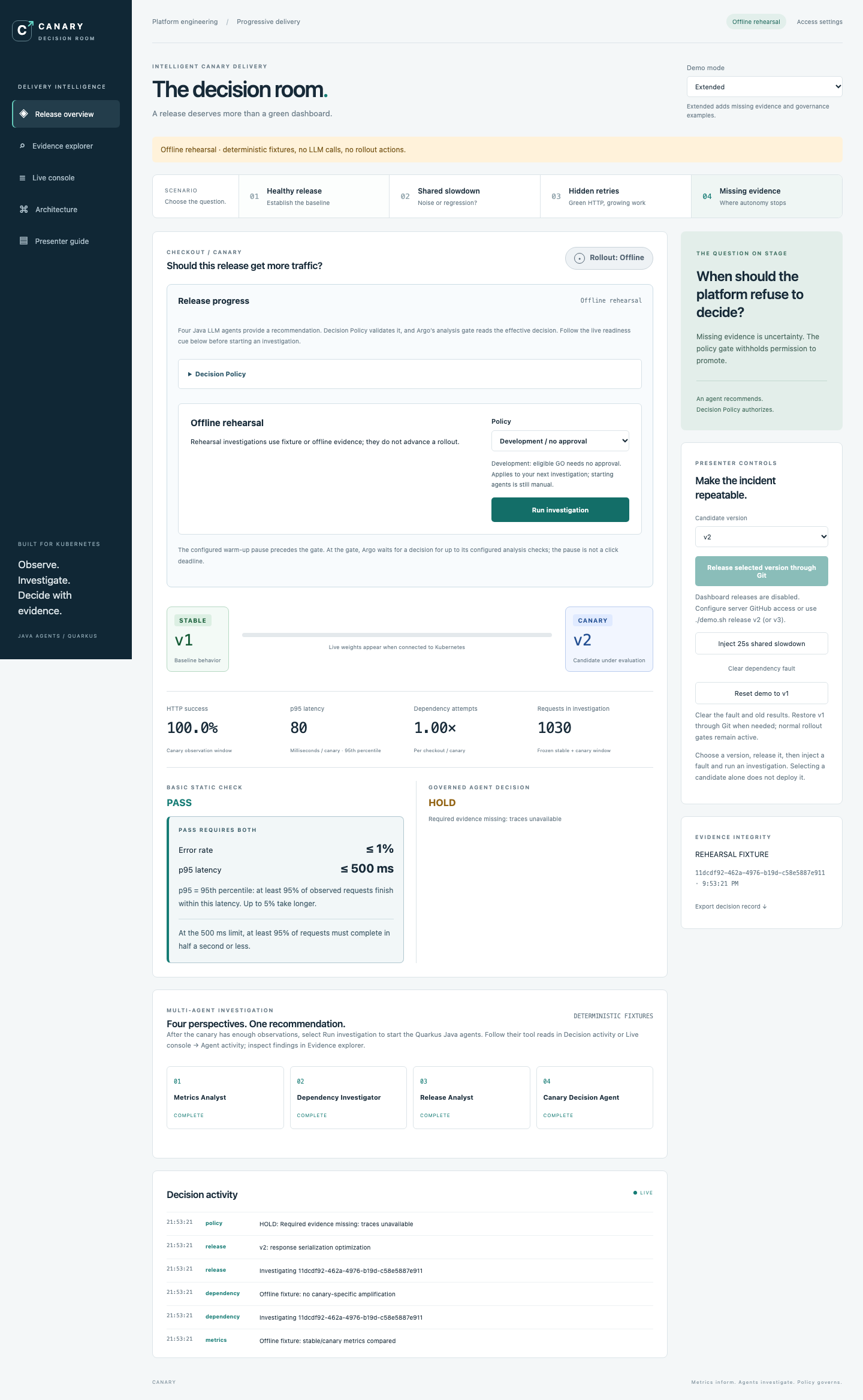
Local rehearsal fixture: healthy HTTP metrics do not satisfy the required evidence contract. The deliberate missing-trace scenario produces HOLD without a live telemetry outage or model call. Inspect the missing entry and saved policy reason in Evidence explorer.
Scenario 02 asks whether a slowdown is shared, scenario 03 exposes hidden retry cost, and scenario 04 shows where automation must stop because it cannot justify a decision.
3. Inspect the deterministic checks
The platform validates:
- Evidence freshness: decisions expire 120 seconds after capture.
- Minimum traffic: at least 30 observed requests per revision.
- Required evidence and successful mandatory tool reads.
- Valid specialist findings and final evidence references.
- The hard 10% canary error cap.
- Customer health before GO: p95 at most 500 ms and errors at most 1%.
- Production approval when applicable.
- The current release, pod-template hash, and rollout step at analysis time.
Java-computed tool comparisons keep milliseconds and sample thresholds explicit. A targeted consistency review catches false sample-shortage and latency-limit claims, allows one correction using the same frozen evidence, and retains original/corrected reports in Evidence explorer. It does not establish root cause or guarantee that every prose error is detected. Unresolved contradictions retain HOLD unless independently corroborated hard safety evidence requires NO-GO.
Model execution has an 85-second orchestration deadline, bounded per-call timeouts, and a 12-tool investigation budget. Failures and unfinished investigations produce HOLD. Local fixture decisions cannot authorize a live rollout.
4. Follow the Argo contract
The shared AnalysisTemplate polls the authenticated decision endpoint every five seconds:
GOsatisfies the success condition.NO_GOsatisfies the failure condition.HOLDsatisfies neither and remains inconclusive while the measurement budget lasts.
The template allows 180 HTTP checks at five-second intervals—roughly 15 minutes plus execution overhead. These polls read the saved decision; they do not invoke the LLM. A completed inconclusive run does not automatically restart. Fix the cause, then re-enter the same release through GitOps with a fresh pod-template identity or release a new candidate:
This helper uses the Git release path and requires a clean working tree. It creates a fresh pod-template identity and does not force promotion. The SPA’s release/reset controls provide the corresponding fresh-run path without changing consoles.
5. Export the decision record
Use Export decision record in the UI. It includes source evidence, findings, recommendation, policy result, and investigation identity.
Demo retention
Recent decisions and observations are bounded in-memory data. Prometheus and Jaeger use ephemeral storage. Export records before restarting. Production audit retention, encryption, and access review are separate concerns.
Checkpoint
You can demonstrate a model recommending GO while policy withholds authority, and explain why approval cannot override stale or missing evidence.
Review the presenter playbook to choose the 10-minute or 15-minute flow.
Next: Plan production automation to compare manual triggers, automatic investigation with human review, and unattended promotion, including fault coordination and implementation options.